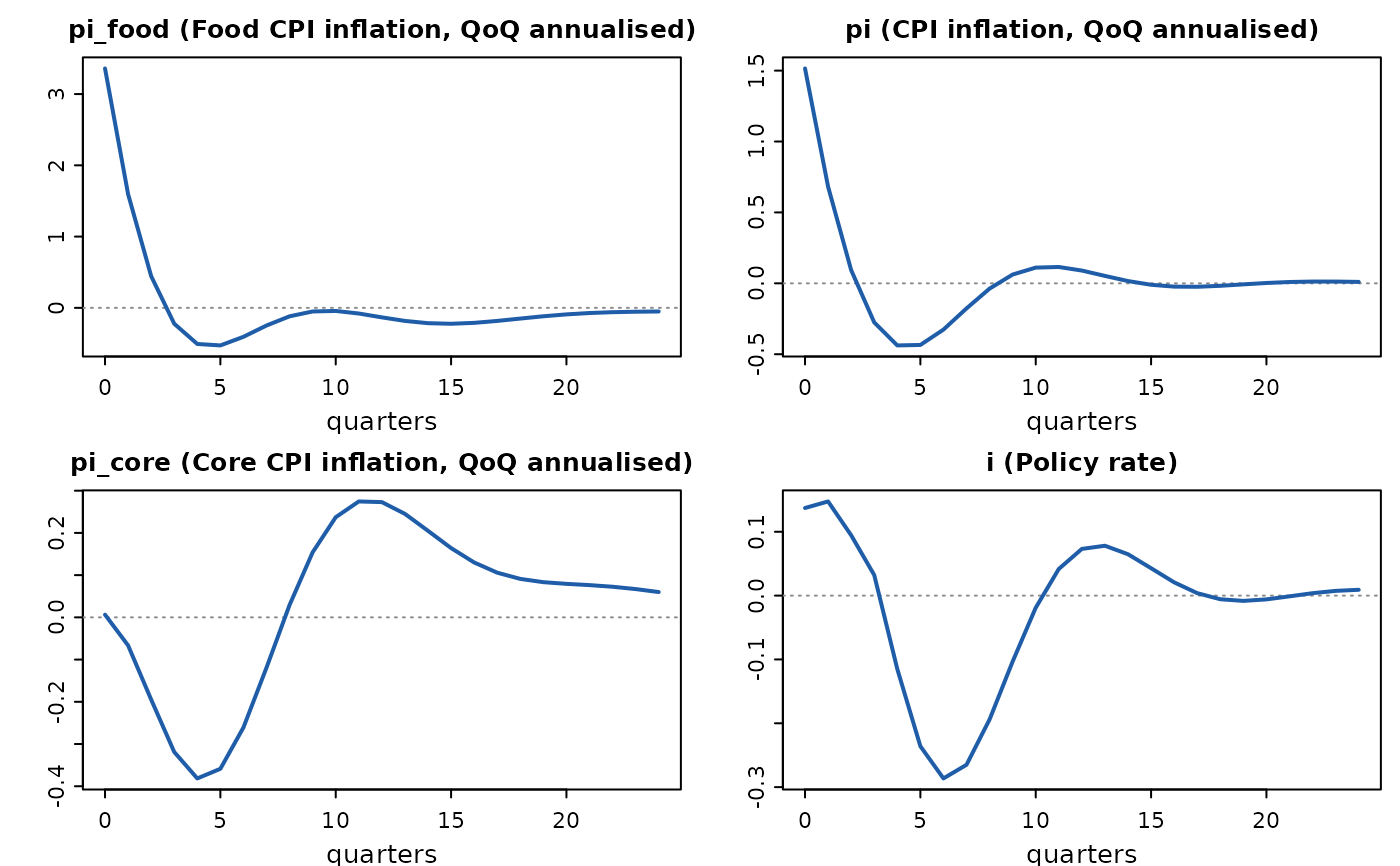
Splits headline inflation into food and core. Food is 30-50 percent of the consumption basket across most of sub-Saharan Africa and South Asia, and a single-inflation model is unusable there: supply shocks to food dominate headline, but monetary policy should look through the relative-price component. Practically every technical-assistance engagement rebuilds this split by hand.
Usage
block_food_cpi(
  weight = 0.35,
  persistence = 0.5,
  demand = 0.2,
  passthrough = 0.25,
  correction = 0.1,
  sd = 3
)
Arguments
- weight
Food share of the CPI basket (
w_food).- persistence
Food inflation persistence (
f1).- demand
Output-gap coefficient in food inflation (
f2).- passthrough
Real-exchange-rate coefficient in food inflation (
f3); normally larger than core's, food being more tradable.- correction
Error-correction speed on the relative food price (
f4); must be positive for the relative price to be pinned down.- sd
Standard deviation of the food supply shock.
Value
A qpm_block().
Details
The block replaces headline inflation with an identity and adds:
pi_core— the Phillips curve, now for core inflation (it keeps the template'sb1,b2,b3and theeps_pishock);pi_food— food inflation: its own persistence, expectations of headline, demand, a stronger exchange-rate pass-through than core, and error correction on the relative food price;rp_food— the relative food price gap, which accumulates the food-core inflation differential and mean-reverts throughf4.
Headline is pi = w_food * pi_food + (1 - w_food) * pi_core, so
everything downstream (the 4-quarter average, the Fisher equation, the
policy rule) continues to use headline. To target core instead,
replace the policy rule with another block.